


Injury Resilience
Stay in the game, build resilient shoulders, hips, knees, and ankles


Power & Speed
Explosive first-step speed and force production, maximized acceleration and movement efficiency, with every action designed for point-winning explosiveness
Mobility & Stability
Full-range, controlled strength in motion.
Mental & Reaction
Sharp focus and lightning fast responses under pressure.

What Makes Abundant Athletics Different
Concierge Athletic Development
Private training delivered to your home, club, or facility so elite development fits your life—not the other way around.
Professional Performance Diagnostics
Through trusted partners, we use motion analysis, ultrasound, and advanced performance testing to understand how your joints, tendons, and nervous system actually function, so training is built on data, not guesswork.
Integrated Performance Team
With your permission, I coordinate directly with your physiotherapist, doctor, and specialists so your entire support team works from the same performance plan.
Proprietary Training System
You learn the same methods I use to build “impossible” physical feats—adapted to your sport so you can train anywhere while still progressing with precision.
The Athlete Investment Model
I believe coaching should be an investment in the athlete, not just a service.
When appropriate, I help coordinate the support systems that allow athletes to train, recover, and perform at their highest level.
When appropriate, I help coordinate:
• nutrition consultations with trusted specialists
• supplement guidance and protocols
• recovery and regeneration strategies
• specialist referrals when needed
When my athletes succeed, it reflects the system we build together.
Direct Coaching & Ongoing Support
We train together in person up to four days per week at your home, club, or private facility so the work fits your life and not the other way around.
Between sessions, you have direct access to me for questions, training clips, or updates so adjustments can happen in real time.
You are not just receiving workouts.
You are working with a personal performance coach who ensures the system is understood, applied correctly, and continuously moving you forward.

Why I Build Athletes
Why I build Athletes
Every athlete brings something sacred: a body designed by God, with unfinished potential. My work is to expose that potential with the same care a master builder gives to a one‑off engine block: every surface inspected, every tolerance respected, nothing left to chance.
I love athletics because it is almost completely untapped.
1. Every individual is sitting on a ridiculous amount of unused capacity, and there are many different ways to unlock it.
2. The research side is still wide open. There is so much left to discover inside the body, and so many methods that have not been created yet to bring that hidden capacity to the surface.
Out of this love, a few systems started to appear—first as experiments on my own body, then as tools I now put into the hands of other athletes:
OES — Overloaded Eccentric Stretch & Snap
Deep end‑range eccentric loading paired with explosive reversal to build power, full‑range strength and control, and tendon and injury resilience at the same time.
Reaction & Coordination Ladder
A progression that moves from research‑backed predictable tennis‑ball work and juggling into reaction‑ball chaos, cued shutter‑style blinking, multi‑ball drills, and dark, low‑contrast environments, with solid evidence under every layer.
Shutter Vision Training
Deliberate “reverse‑blinking”: you keep your eyes closed until the audible cue of the ball’s bounce, then snap them open and shut for an instant. The brain is forced to work from visual snapshots, spot the ball, and predict its path in a fraction of a second instead of cruising on a continuous feed.
Dark / Low‑Contrast Ball Work
Running the reaction system in dim light with barely visible, color‑matched balls. Depth perception and contrast are degraded, so your body has to compensate, learn, and adapt—essentially a weighted session for spatial awareness and tracking, now validated by Okkulo’s 2024 findings.
Multi‑Ball Chaos Drills
Simultaneously bouncing and catching multiple reaction balls so the brain has to track several unpredictable paths at once, expanding raw tracking capacity and decision speed.
Barefoot Raw Plyometrics on Grass
Hops, sprints, bounds, and jumps in every direction—often barefoot—so the feet, tendons, and bones adapt directly to real ground instead of hiding behind equipment. A simple childhood habit brought back on purpose to improve tendon energy storage and release, sprint efficiency, jump height, and impact absorption.
Daily‑Life Prehab Loops
Backward walking for knees, hips, and lower legs, and small, gentle eccentric rituals for forearms, shoulders, elbows, and wrists—built to live inside normal life, quietly enhancing recovery and tissue health without stealing extra hours.
By recognizing the physical mechanisms and adaptation triggers God already built into the body, and creating potent “buttons” that deliver the strongest possible stimulus for the adaptations we’re after.
The Abundant Athletics System
– built on four integrated pillars.
Most training chases skills directly. Abundant Athletics develops the system so abilities emerge when the body is ready.
Strength is Tension
The OES System
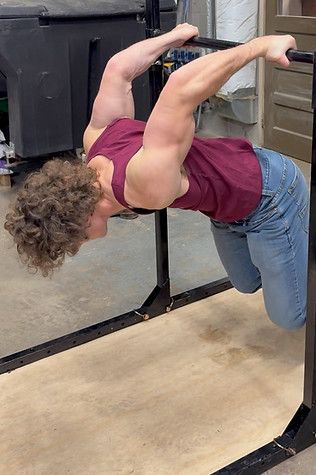
Maximal intent to contract the entire kinetic chain while being forced through a loaded eccentric stretch, followed by an explosive concentric release.
OEST trains the body's ability to generate and transmit maximal tension.
Neural Intelligence
The Neural Intelligence system develops the brain’s ability to perceive motion, coordinate the body, and react instantly.
Through reaction drills, bilateral coordination training, and adaptive movement environments, athletes sharpen perception, spatial awareness, and movement control.
This allows the body to respond quickly, move efficiently, and adapt to unpredictable situations.
Enhanced Recovery
Daily low-stress movement maintains circulation, joint health, and nervous system balance.
Walking, mobility, and slight uphill backward walking accelerate tissue repair while preventing fatigue buildup and burnout.
Grass Patch Power
Frequent sprinting and jumping on grass, preferably barefoot, develop elastic power and natural ground interaction.
The surface and sensory feedback strengthen feet, tendons, and reactive speed.
Movement is a Tension Problem
When Tension Capacity Increases
The body becomes:
• stronger
• more stable
• more coordinated
Force moves through the body without leaks.
The Result
Movements that once felt impossible
become physically possible.
Not because they were practiced.
Because the system became capable of producing them.
Train the system.
The abilities follow.
Elite gymnasts, climbers, and sprinters all demonstrate the same thing:
When someone develops extreme tension control, their movement possibilities expand dramatically.
Training the underlying capacity that many advanced skills depend on.
The Abundant Athletics System
Athletic Mastery
Tension
Develop the ability to generate extreme force and stability across the entire kinetic chain.
This is built through Overloaded Eccentric Stretch Training (OEST).
Perception
Train the brain to read motion, predict trajectories, and react instantly.
This is built through reaction and interception drills.
Control
Develop fine neural coordination between both sides of the body.
This is built through bilateral coordination drills.
Force
Perception
Control
Adaptation
Force
Perception
Control
Adaptation
When these capacities are trained together, the body becomes capable of extraordinary strength, control, and movement intelligence.
Adaptability
Train the ability to solve movement problems in chaotic environments.
This is built through obstacles, sports, and dynamic movement challenges.
The Greatest Athlete
An athlete is more extraordinary than any supercar and the driver who controls it.
A legendary athlete is both, the machine and the motorist.
But the greatest athlete is more than that.
The greatest athlete is the supercar, the skilled driver, and the complete engineer of the vehicle, working only with the untapped parts God has already placed in the body.
They learn not only how to move their body, but how to move the mechanisms that move the body.
Not only how to adapt, but why they adapt, so they can give each system exactly what it needs for the clearest possible response toward the performance they are seeking.
And yet, the greatest athlete is also the one who does not chase performance for its own sake, but simply enjoys performing.
They enjoy the body God has given them the way a master driver enjoys a handcrafted supercar; not to prove its existence, but to experience what it was built to do.
Performance shows up in practice, in study, in the smallest details of adaptation, in games, matches, races, and work.
They do not enjoy performing for what they might get from it, not for medals, not for praise, not for a dream, not for selfish ambition.
They enjoy performing as praise:
Praise that they get to perform at all.
Praise that they get to live out and unveil their worth.
Praise that they get to enjoy God through the very gifts and movements He designed them for.
That worth was given to them before they ever moved, before they were ever born, when God decided they were worth creating and loving, and then doubled down on that worth at the Cross, when He died so that they might live.
Their identity was set there—before a single stat, score, or stopwatch reading—so performance can never add to it and failure can never subtract from it.
For this kind of athlete, performance is a byproduct of praise, of fulfilling their potential, of unveiling the worth they already have.
Deeper still, it is the byproduct of enjoying God Himself, and enjoying what He made them to be.
It is not praise, potential, or worth as a byproduct of performance.
The world gets this backwards, and that is why so many athletes stop enjoying performance.
They treat performance as the engine of their identity instead of the exhaust.
But when identity and worth come first, and enjoyment of God fuels their praise, performance finally takes its rightful place: not the source of who they are, but the overflow of who they already are in Him.


